Marine Oxidation Removal: Why Your Boat Looks Chalky
Understand what causes gel coat oxidation on boats and how to remove it. Testing severity, hand vs machine methods, and prevention for Canadian waters.
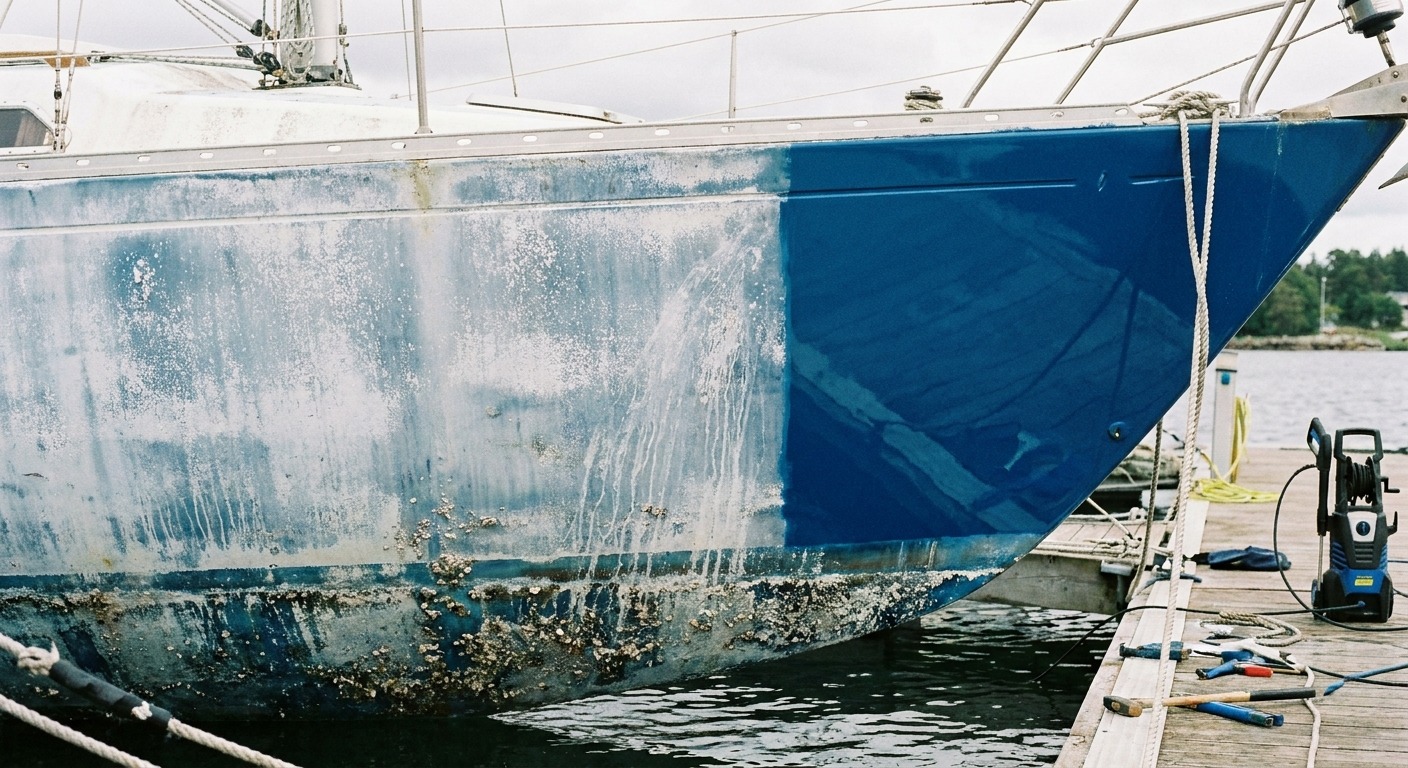
Every boat owner has seen it. That brand-new deep blue hull that looked incredible at the dealership is now a washed-out, chalky imitation of its former self. Your white boat has gone from bright and glossy to a flat, porous-looking grey. This is oxidation, and it is the single most common cosmetic problem on fibreglass boats in Canada. The good news is that in most cases it is completely reversible. The bad news is that ignoring it makes it progressively harder to fix and eventually leads to permanent damage.
What Oxidation Actually Is
Oxidation on gel coat is not rust. It is ultraviolet degradation of the polyester resin that makes up the gel coat surface. When UV radiation hits gel coat, it breaks the molecular chains in the resin. These broken chains release as a chalky powder on the surface, the gel coat disintegrating one microscopic layer at a time.
The pigment particles do not degrade as quickly as the resin binding them. As the resin breaks down and washes away, pigment particles sit loose on the surface without binder. This is why oxidized gel coat feels chalky and why rubbing it transfers colour to your hand. You are wiping away loose pigment that has lost its resin matrix.
On white gel coat, oxidation shows as a dull, flat appearance rather than a dramatic colour change. On coloured gel coat, the effect is more obvious because the colour fades and shifts. Red turns pink. Dark blue turns powder blue. Black turns grey. The pigment is still there, buried under the degraded surface layer, which is why compounding can bring the colour roaring back.
Tip: Apply a small amount of water or rubbing alcohol to an oxidized section. If the colour appears to restore momentarily while wet, the pigment is intact below the degraded surface layer, and the oxidation is removable. If the colour does not change even when wet, the degradation has gone deeper and you may need more aggressive restoration or professional help.
Why Canadian Boats Oxidize Faster Than You Think
There is a common misconception that Canadian boats suffer less oxidation than Florida or Caribbean boats because of shorter seasons. The reality is more complicated. Canadian boats face intense UV during June, July, and August when the sun angle is high and days are long. A boat sitting uncovered at a dock in Georgian Bay from May to October gets hundreds of hours of direct UV exposure.
Then there is winter storage. Shrink wrap protects against snow and rain but does nothing against UV. A white shrink wrap lets substantial UV through. Tarps that are not UV-stabilized degrade themselves and offer diminishing protection over the winter. Some boaters store their boats outdoors and uncovered, which means the gel coat is getting UV year-round, even in winter when the low sun angle creates long exposure hours on vertical hull surfaces.
Water conditions matter too. High mineral content in lakes like Simcoe and Couchiching leaves deposits that trap moisture against the gel coat, accelerating degradation. The freeze-thaw cycles during shoulder seasons force moisture in and out of the gel coat's porous surface, which mechanically stresses the already UV-weakened resin. All of this adds up to oxidation rates that surprise people who assumed their freshwater, northern climate boat would hold up better than a southern saltwater vessel.
Testing Oxidation Severity
Before you reach for a compound and polisher, assess what you are dealing with. The severity determines your approach, your product selection, and your time investment.
- The finger test: Run your dry finger firmly across the gel coat. No residue means the surface is in good shape and just needs cleaning and wax. Light residue means mild oxidation that a cleaner wax can handle. Heavy chalky residue means moderate to severe oxidation that requires compounding.
- The water test: Spray water on the surface. If it beads and sheets off, you have wax or sealant still present. If it soaks in and darkens the surface, the gel coat is unprotected and porous. The degree of water absorption correlates with oxidation severity.
- The colour test: Wet the surface and compare the wet colour to a protected area, such as under a rub rail or inside a storage compartment. If the wet colour matches the protected area, your colour is intact under the oxidation. If it does not match even when wet, the degradation has gone into the pigment layer.
- The scratch test: Scratch the surface lightly with your fingernail. On healthy gel coat, your nail slides without marking. On severely oxidized gel coat, your nail can actually dig a groove because the resin has lost its structural integrity.
These four tests take less than five minutes and save you from applying the wrong approach. A boat that just needs a cleaner wax does not need aggressive compounding, which would remove healthy gel coat unnecessarily.
Hand Removal vs Machine: Making the Right Call
For mild oxidation, hand application of a marine cleaner wax is entirely adequate. Apply with a foam applicator pad, work it into the surface with moderate pressure in overlapping circular motions, let it haze, and buff off with a clean microfibre towel. The abrasives in the cleaner wax cut through the degraded surface layer while the wax component protects the fresh gel coat underneath.
For moderate oxidation, hand application becomes impractical on anything larger than a dinghy. The physical effort required to generate enough cut to remove oxidation by hand on a 25-foot hull would exhaust most people before they finished one side. This is where a dual-action polisher transforms the job. A DA polisher with a medium-cut compound on a foam cutting pad handles moderate oxidation efficiently and safely. The random orbital action of a DA makes it very difficult to burn through gel coat, which gives you confidence to work the compound until the oxidation is gone.
For severe oxidation, you may need a rotary polisher or a long-throw DA with a wool cutting pad. The increased aggressiveness cuts through the thick degraded layer faster. Rotary polishers require experience because they generate concentrated heat that can burn through gel coat quickly, especially on edges and contours. If your oxidation is severe enough to warrant a rotary, consider whether wet sanding first might be more efficient. Our gel coat restoration guide covers the wet sanding process in detail.
Restoring Colour Depth
Compounding removes the degraded layer and exposes fresh gel coat, but the finish after compounding alone is not perfect. Compound leaves micro-marring, fine scratches from the abrasive particles, that dull the surface. On white gel coat this is barely noticeable. On dark colours it is very obvious, showing as swirl marks and haze in direct light.
A finishing polish after compounding removes the micro-marring and brings the surface to full gloss. Use a softer pad, a finer polish, and lower pressure. The same paint correction principles that apply to automotive clear coat apply here: each step refines the scratch pattern left by the previous step until the scratches are too small to see or reflect light.
The colour depth you can achieve on a properly restored gel coat is remarkable. Forums on sites like BoatLife are full of before-and-after photos that show the transformation. Many boat owners are genuinely shocked at the colour hiding under the oxidation. A boat they assumed was light blue turns out to be a deep cobalt. A beige boat reveals itself to be a rich cream. That moment when the compound bites through the oxidation and the real colour appears under the pad is one of the most satisfying experiences in detailing.
I have seen boat owners tear up when they see the original colour come back after years of looking at a faded hull. That alone makes the work worthwhile.
Prevention: Keeping Oxidation From Coming Back
Restoration without protection is a waste of your time. Once you have removed the oxidation and polished the gel coat, you need to protect it immediately. Every hour of unprotected UV exposure starts the degradation cycle again.
At minimum, apply a marine paste wax. For longer protection, a polymer sealant or marine ceramic coating provides months of UV resistance. Reapply wax every six to ten weeks during the boating season and once before winter storage. If you use a ceramic coating, follow the manufacturer's maintenance schedule, which typically involves a spray sealant touch-up every few months.
Beyond product protection, physical UV barriers are your best defence. A quality boat cover blocks virtually all UV when the boat is not in use. Covered storage, whether in a barn, marina building, or under a permanent canopy, eliminates UV exposure entirely during storage. For winterizing, use a UV-stabilized shrink wrap or a cover specifically designed for long-term outdoor storage.
The reality is that oxidation is inevitable on any gel coat surface exposed to UV. You cannot prevent it permanently. But you can slow it dramatically with consistent protection, extend the intervals between restorations, and maintain the value and appearance of your boat through decades of Canadian boating seasons. For tips on cleaning and protecting the rest of your boat, including vinyl, canvas, and hardware, our comprehensive boat detailing guide walks through every surface. And for general information on surface protection technologies, including how ceramics differ from traditional waxes, check out our ceramic coating explanation.