DA vs Rotary Polisher: Which Do You Actually Need?
Dual-action vs rotary polisher comparison for car and boat detailing. Throw size, speed control, safety for beginners, and when rotary is necessary.
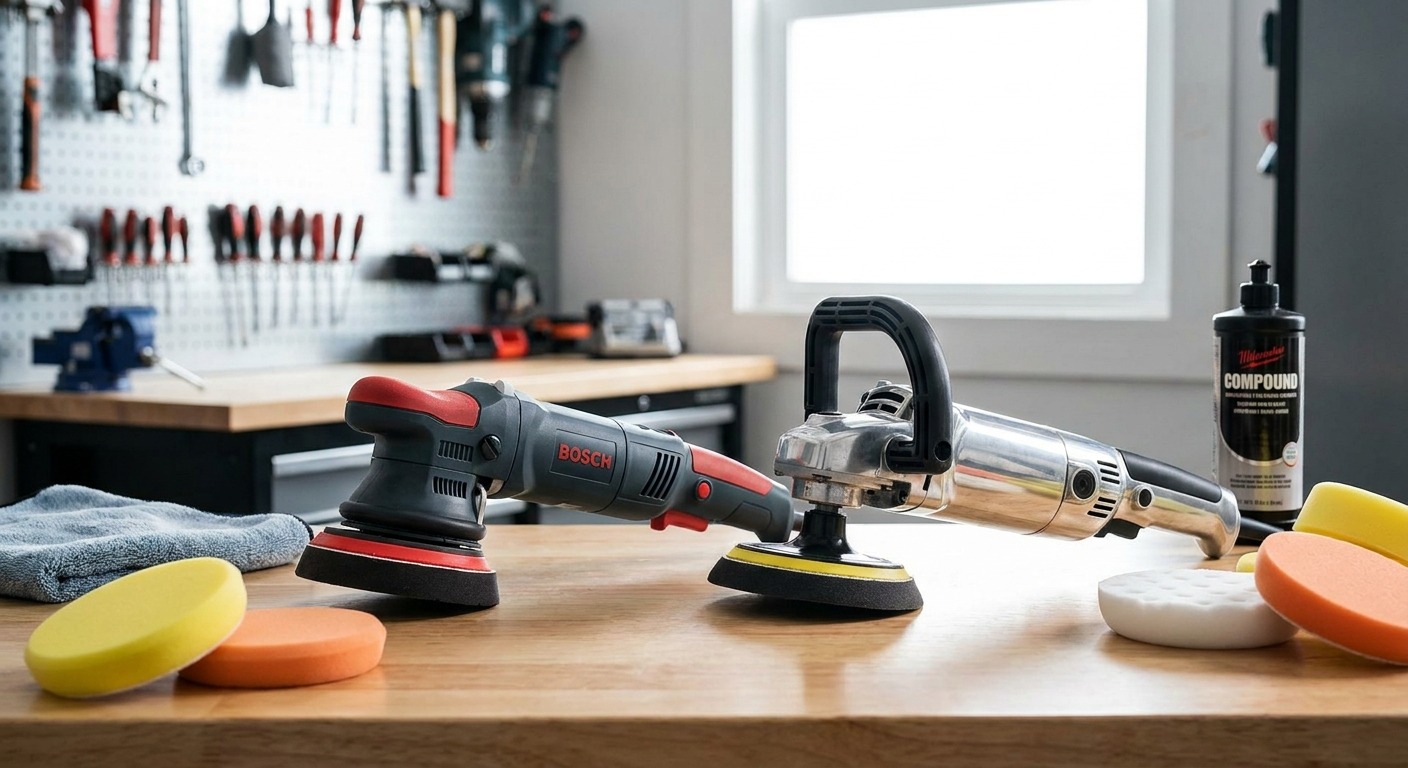
The polisher question comes up more than any other gear discussion in detailing. Should you buy a dual-action or a rotary? The internet is full of strong opinions on this, and a lot of them are either outdated or just wrong. The short answer is that 90 percent of detailers, including professionals, do the vast majority of their work with a dual-action polisher. The rotary is a specialist tool for specific situations. Here is the longer, more useful answer.
How a Dual-Action Polisher Works
A dual-action polisher, also called a random orbital polisher, moves the pad in two simultaneous motions. The pad spins on its own axis while the entire spindle assembly orbits around a central point, producing an irregular pattern that never concentrates heat or abrasive action in one spot for long. Resources like Autogeek have good visual breakdowns of how this motion works. If you stop moving the machine, the pad oscillates in a complex pattern rather than spinning in one place.
This random motion is the key safety feature of a DA. It makes it very difficult to burn through paint or gel coat, even for a complete beginner. The worst you are likely to do with a DA is fail to remove a defect. You are extremely unlikely to create new damage. This alone makes it the right starting point for anyone new to machine polishing.
Modern DAs come in two varieties: free-spinning and forced rotation. A free-spinning DA allows the pad to stop spinning if you apply too much pressure, which further limits the risk of damage. A forced-rotation DA, sometimes called a gear-driven DA, maintains pad rotation regardless of pressure. Forced rotation DAs have more cutting power than free-spinning models, approaching rotary capability while retaining much of the DA's safety margin. They are an excellent middle ground for experienced users who want more correction ability without the full risk of a rotary.
How a Rotary Polisher Works
A rotary polisher is mechanically simple. The motor spins the pad on a single axis, like a drill. The pad spins in one consistent direction at whatever speed you set. There is no orbital motion, no random pattern, and no safety mechanism to prevent heat concentration.
This directness is both the advantage and the danger. A rotary generates concentrated heat and friction exactly where you place it. In skilled hands, this means faster cutting through severe defects, heavy oxidation, and sanding marks. In unskilled hands, it means burned-through clear coat, holograms, and expensive repaints. A rotary can burn through automotive clear coat in seconds if you pause in one spot at high speed with a cutting pad.
Rotary polishers also produce a characteristic defect pattern called holograms or buffer trails. These are fine, directional marks left by the consistent rotation. They are visible in direct light, especially on dark paint, and require a finishing pass with a DA or a very fine rotary step to remove. This means rotary work almost always requires a DA follow-up, which is why many professionals use the rotary for heavy correction and the DA for finishing.
Throw Size: Why It Matters More Than You Think
The throw of a DA polisher is the diameter of the orbital path. It is measured in millimetres and typically ranges from 8mm on small models up to 21mm on long-throw machines. This number is more important than the speed rating for determining how a DA performs.
A short-throw DA (8-12mm) moves the pad in tight orbits. It generates less heat, has less cutting power, and is easier to control in tight spaces. Short-throw machines are good for finishing work, small panels, and working around contours.
A long-throw DA (15-21mm) swings the pad in wide orbits. This generates more friction, more heat, and significantly more cutting power. A 21mm throw DA with a cutting pad and heavy compound approaches the correction capability of a rotary polisher while retaining the DA's inherent safety. The trade-off is that long-throw machines are harder to control on edges and small panels because the aggressive pad movement wants to walk off surfaces.
Tip: For your first polisher, a 15mm throw DA is the sweet spot. It has enough cutting power for moderate paint correction work, enough control for finishing, and enough versatility to handle cars, boats, and motorcycles. You can add a long-throw or rotary later if you find you need more aggression.
Speed Control and How to Use It
Both DA and rotary polishers have variable speed control, usually a dial numbered 1 through 6. On a DA, speed 1 is for spreading product and speed 3 to 5 is the typical working range. On a rotary, the useful range is narrower because higher speeds generate exponentially more heat.
A common beginner mistake is running the polisher too fast. Higher speed means more heat, and heat is the enemy. Heat softens clear coat, filling defects temporarily rather than removing them. When the surface cools, defects reappear. Lower speeds with more passes produce permanent correction. Higher speeds produce temporary improvement that disappoints you the next morning.
On a rotary, speed discipline is even more critical. Professional users rarely exceed speed 4 for cutting and speed 2 to 3 for finishing. More passes at moderate speed outperforms high speed every time. This patience-over-aggression principle applies across all detailing work, from clay bar decontamination to final polish.
Why DA Is Safer for Beginners
The safety difference is not marginal. It is enormous. Here is a practical comparison.
A beginner with a DA and medium-cut compound would need to hold the machine in one spot at full speed for a long time to burn through clear coat. The random orbital action distributes heat across a wider area than the contact patch. A beginner might achieve mediocre results with a DA, but they will not destroy the paint.
A beginner with a rotary can burn through clear coat in under ten seconds by pausing on an edge or working one area too long. There is no safety margin. The machine does exactly what the operator tells it to, with no forgiveness. On panel edges, where clear coat is thinnest, the risk is even higher.
Start with a DA. Learn to read the paint. Understand how compound, pad, speed, and pressure interact. Once you can consistently achieve a swirl-free finish with a DA and understand why each variable matters, you have the knowledge foundation to use a rotary safely. Jumping straight to rotary is like learning to drive in a race car. It is possible, but the tuition is expensive when measured in repaint bills.
When Rotary Is Actually Necessary
Despite everything above, there are situations where a rotary polisher is the right tool.
Heavy wet sanding removal is the most common scenario. If you have wet sanded a surface to remove orange peel, heavy oxidation, or a clear coat defect, the sanding marks left by even 3000-grit paper require aggressive cutting to remove. A long-throw DA can handle this, but a rotary with a wool cutting pad does it in half the time. When you are cutting through sanding marks on the hood of a car or the hull of a boat, that time difference matters because it means less heat exposure total, even though the rotary generates more heat per second.
Boat hulls are another common rotary application. Large, flat gel coat surfaces with heavy oxidation respond well to rotary compounding because you can cover area efficiently. Marine gel coat is softer than automotive clear coat, so the burn-through risk is lower, though not zero. See our gel coat restoration guide for specific advice on machine polishing marine surfaces.
Hard ceramic clear coats on some newer vehicles resist DA correction because the random orbital motion does not generate enough sustained cutting action. These coatings require either a forced-rotation DA or a rotary with precise technique to correct. This is a niche situation but one that professional detailers encounter regularly.
Own both. Use the DA for 90 percent of your work. Reach for the rotary when the DA cannot get the job done, and respect the difference every time you switch.
Choosing Your First (or Next) Polisher
If you own nothing, buy a 15mm throw DA from a reputable brand. Pair it with a medium-cut foam pad and an all-in-one compound/polish for your first experiments. Practice on a junkyard panel before committing to a full vehicle. The machine, pad, and compound will run you less than a professional detail costs, and you will use it for years.
If you already own a DA and find yourself limited by its cutting power, a forced-rotation DA is a better upgrade path than jumping to a rotary. You get 80 percent of the rotary's correction capability with 80 percent of the DA's safety margin. Rotary should be your third polisher, not your second, unless your work is specifically in heavy correction, marine, or professional production detailing where speed justifies the risk.
Whichever machine you choose, pair it with quality pads and towels. A premium polisher with cheap pads underperforms a mid-range polisher with premium pads. The pad is where the work happens. The machine just moves it. For guidance on the towels you will need for buffing compound and polish residue, see our microfibre towel guide. And if you are working specifically on marine oxidation, the combination of the right machine and right compound makes the difference between a frustrating weekend and a satisfying transformation.